Mary I, a Fashion Icon? - a style analysis and how she influenced 16th century fashion trends

When we think about historical fashion icons, someone that probably doesn't come to mind immediately is Mary I; particularly not when you compare her to her sister Elizabeth I and her characteristic giant ruffs and elaborate headdresses. But Mary had both a personal love of fashion and finery, and a significant role in the developing fashion trends of the mid-to-late 16th century, and the way she dressed not only shows us who she was, but also represents what mattered most to her.
Despite not being famed for her appearance or style as other monarchs were, Mary cared a lot about her attire and how she was seen by her subjects, and often indulged herself with new gowns in fine fabrics and pricey jewels – something that was emphasized by how plainly Elizabeth dressed when Mary was queen, so much so that Mary would force her younger sister to dress up more extravagantly for special occasions and appearances at court.
A memorable gown of Mary’s was the one she wore for her first public appearance as queen in 1553: an exquisite gown of purple velvet with a purple satin kirtle, bedecked in pearls, jewels, and gold detailing. The significance of this outfit is the colouring. The colour purple has long been synonymous with royalty due to how hard and expensive it was to make, and historically only direct members of the royal family were allowed to wear it. After Mary's legitimacy had been stripped away, taken out of her hands and debated for most of her life, and then called into question again when Edward VI organised for Jane Grey to become queen instead of her, this was Mary triumphant at last – publicly and proudly reclaiming her throne and flaunting her royal blood, something she had not been permitted to do for the majority of her life. This instance shows that not only was she fond of rich, intricate gowns as her garment of choice (especially for big occasions), but also that she was very conscious of her clothing choices and what messages they sent.
How 'The Lady Mary' Dressed:

How 'The Lady Mary' dressed In order to accurately identify the key components of Mary's wardrobe as queen, we need to look back to her earlier years, to when she was largely under the rule of others, most prominently her father. After Anne Boleyn had given birth to Elizabeth, Henry removed Mary from the succession, reducing her title to 'Lady Mary' rather than being rightfully acknowledged as Princess, and used cruel tactics in an attempt to pressure her into declaring Katherine of Aragon's marriage to him – and therefore Mary's claim to the throne – as illegitimate.
Not many portraits of Mary from this time are available, but we can see from this one (painted in 1544) that her fashion isn’t particularly unique here. Though her gown is distinguishable as finely made with extensive detail and plenty of jewels (as befitting her status), the square-necked gown and French hood are exactly the same style that other ladies at court would be wearing. This rather reflects Mary's situation at the time. At this point she had been reinstated to the succession but was still in a precarious position – her relationship with Henry was likely strained, and her future wasn't deemed as important as Edward's, Henry's golden child.
How 'Queen Mary' Dressed:

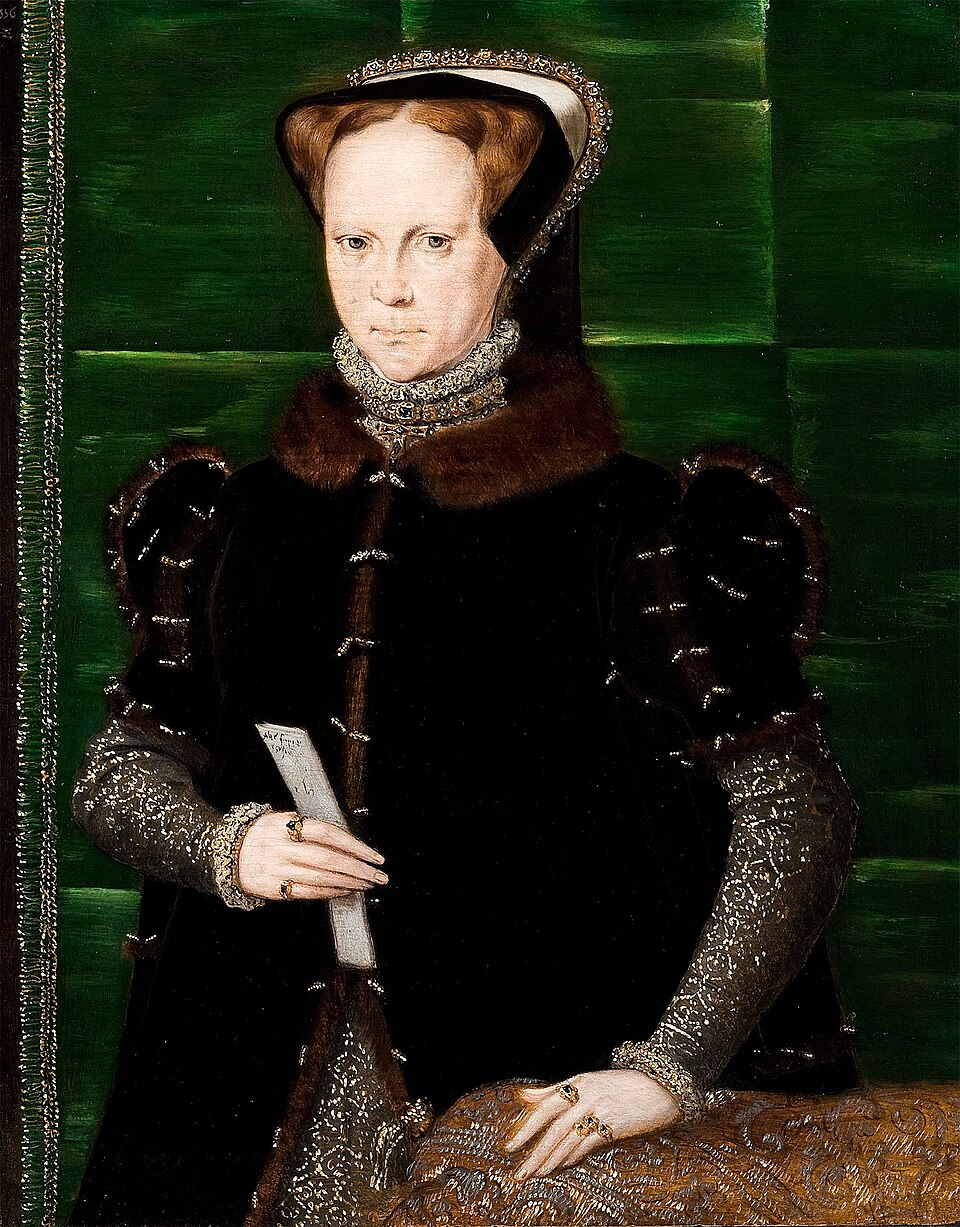
Looking at any portrait of Mary from 1553 onwards, the differences in her attire are plain to see. Gone are the low-cut French style necklines, replaced by gowns with full-coverage partlets that, in stark contrast, reach right up to the neck in a prominent standing collar. Because of this change, the neckline cannot be lined with jewels as before, and so she adorns her collar instead with intricate embroidery and frills, and wears thick jewel-encrusted belts, heavy crucifix necklaces, and, in nearly all portraits, a large, prominent brooch on the centre of her chest. Her hood is lined with gems and pearls too, and though it displays the front section of hair similarly to a French hood, the silhouette is different, pointing out into corners either side rather than following the curve of the head, contributing to what is overall a more rigid look.
The colours Mary wore as queen were noticeably darker than previously popular styles. Colour was a distinguishing feature of Henry VIII's court. Though there were Sumptuary Laws in place, governing who was permitted to wear what garments and colours, the rules were a lot more lax when it came to women, so women at court sported a rich array of brightly coloured gowns. By contrast, Mary's queenly gowns were mostly in deep shades of brown, red, and black. To a modern eye this might seem like a dull or mournful choice, especially for a queen who could wear more exclusive colours like purple, but black clothing was a Tudor status symbol. Like purple, black fabric was extremely difficult and expensive to make, so much that many would opt for an 'off-black' that was cheaper to acquire but not quite as deep and rich a shade as true black. However, black dye did become somewhat easier to obtain thanks to imports from new world explorations (like logwood tree extract), and during Mary's reign black quickly became a popular colour at court as people rushed to copy the queen, and attempted to give themselves an air of wealth and status. But there may have been a more significant reason why Mary favoured these darker colours.
Mary's Ties to Spain:
During Henry VIII's reign a lot of courtly fashion was influenced by French trends (the square neckline gowns were often referred to as 'the French style'), which were more revealing than previous English fashions (most notably the French hood that allowed for a glimpse of a woman's hair, which was considered to be daring at the time). But Mary's attire clearly strays in a different direction.
Spanish fashion in the 16th century was a lot more structured, formal, and layered. Farthingales were used to give skirts a specific shape, and garments like the ‘ropa’ – a gown with fastenings meant to be worn as an overcoat, usually worn loose or open at the waist – were popular. Darker colours were generally preferred, as well as details like intricate embroidery, sleeves that puffed a little at the shoulder, and high necklines with modest ruffs. In one of Mary's portraits (below) she is wearing what looks to be a distinctly Spanish-inspired gown, judging by the fastenings that open at her waist, the puffed upper sleeves, and the high ruff-like collar that sits just under her chin.
It makes sense that Mary would adopt Spanish fashions. Not only was it a predominantly Catholic nation, but it was also close to her heart because of her ties to her mother and her husband. Mary's marriage to Philip II of Spain in 1554 forged what they hoped would be a powerful alliance between Spain and England to strengthen Mary's Catholic cause, but it was famously not the most successful match, for many reasons. For one, their relationship was difficult; Philip could not live in England with Mary permanently, and it is generally considered that Philip did not feel as strongly for Mary as she did for him. On top of this, the people of England did not take kindly to Mary's new king. Mary's advisors discouraged the match from the beginning, and her subjects disapproved of the marriage, fearful that Spain would now hold too much power and influence over England. Mary choosing gowns inspired by Spanish trends could be seen as an act of love or respect towards Philip, or could have been a more practical decision, an attempt to warm the English public – who were notoriously hostile towards those from different countries or cultures – to her husband, and to show that she approved of this new Spanish presence within England.
Mary's other personal connection to Spain was through her mother, Katherine of Aragon. Mary adored her mother, and was deeply affected when they were forced apart in 1531 when Katherine was banished from court, becoming withdrawn and prone to illness. Even long after Katherine's death Mary continued to honour her at every opportunity – one of Mary's first acts as queen was to rewrite Anne Boleyn's marriage to Henry as unlawful, undoing the declaration that she herself was forced to sign in 1536 that stated the opposite.
In a similar vein, it appears that Mary also paid homage to her mother through her clothing choices, not only by introducing Spanish trends to the English court, but also through her jewellery. From looking at portraits of Katherine and Mary respectively we can see that they both owned a remarkably similar necklace: a large golden cross studded with black stones, hung from a string of pearls. It's unlikely that it is the exact same necklace, as there are subtle differences that set them apart, but they are similar enough that one could safely assume it is meant to resemble a piece her mother owned, particularly when you consider how often Mary is shown wearing it. Mary emulating her mother in this way is particularly poignant because Henry forced Katherine to surrender her jewels to Anne Boleyn before Anne was crowned queen, so this works as another instance of Mary reclaiming her parentage and attempting to right the wrongs of the Great Matter.


The Silhouette of a Queen:
Another possible reason why Mary opted for more structured gowns may have been in an attempt to bulk up her frame. It is well documented that Mary struggled with various ailments throughout her life, like her frequent illnesses as a teenager, her painful menstrual cycles, and her multiple phantom pregnancies during her marriage to Philip. On top of this, the emotional distress from the Great Matter reportedly took a toll on Mary's appearance (similarly to her mother). This meant that Mary often looked pale and severe, and noticeably slender for her short height. Compensating for this with layers of extravagant fabrics and furs would not only disguise her petite frame and make her figure seem fuller (as was desirable at the time), but might also make her seem more attractive, as she was not widely considered to be a great beauty.
Wearing high collars and more rigid, structured gowns also meant that Mary achieved an imposing and characteristic silhouette. For kings (and men in general) it was easier to cut an intimidating figure using clothing – we see this especially in Henry VIII's portraits, with his feathered hats, puffed sleeves, exposed calves, and prominent codpieces. He utilised fashion in a way that accentuated his height, build, and power. For women, there were less options in this regard. Courtly fashion for women in the Tudor era was generally used to construct an idealistic figure – often emphasizing the waist and showing off the neck and shoulders – and to create graceful movement when walking or dancing. Mary's fashion choices set her apart visually from the queens who had come before her (her mother and her stepmothers), which makes sense as she was the first queen of England to rule in her own right rather than being a queen consort, visually signifying the beginning of a new era. And by keeping her style remarkably consistent through all of her portraits she – like her father – deliberately presents a very particular image to the world of status and power, establishing a characteristic look that is emblematic of her values and identity as a ruler.
Mary's Lingering Influence in Fashion:
The standing collars and delicate ruffs that became popular in England during Mary's reign of course evolved into the wider ruffs of the Elizabethan era, the frill of the collar expanding and exaggerating over time into the much larger and more elaborate shapes that Elizabeth wore. Spanish trends like farthingales and decorative puffed sleeves continued to be of great influence, and black was one of Elizabeth's signature colours.
As a whole, Mary's fashion choices as queen reflect both her intentions as a ruler and her personal passions, her clothing acting as an extension of how she reclaimed her throne, her faith, and her parentage, expressing herself in all the ways she had been so restricted previously. And while by present-day standards she is outshone by her sister's style, her personal style, appreciation for fashion, and her influence in trends during her reign and even after her death should not be overlooked.
References:


Comments