The Battle of Flodden: the largest battle between the kingdoms of England and Scotland


Known as the largest medieval battle between England and Scotland, the Battle of Flodden marked a heavy defeat for the Scots and saw their king, James IV, killed.
The cause of this conflict was connected to Scotland’s deep-rooted ties with France, known as the Auld Alliance, which was ‘built upon Scotland and France’s shared interests in controlling England’s aggressive expansion plans.’{1} When Henry VIII invaded France in the August of 1513, the French King Louis XII invoked the terms of the Auld Alliance, which stipulated that ‘if either country was invaded by England the other country would invade England in retaliation.’{2}
Compelled to honour his agreement with France, King James of Scotland mustered his troops near Edinburgh, and King Louis sent arms, captains and funds to aid him with an attack against England. Having triggered the Auld Alliance, Henry likely expected this retaliation, but James did not help his cause by sending notice to England of his plans to invade. The English army gathered during this time, and it was left to Thomas Howard, Earl of Surrey, to command these forces against the Scots. He was 70 years old and an experienced veteran, so when he neared the border on the 4th of September, he had already assembled around 26,000 men.{2}
At the same time, James crossed into England with a much larger army of around to 60,000 men.{3} Thomas Howard got news that James planned to move his army to a hill in Northumberland called Flodden Edge, so he appealed to James to ‘fight on more level ground’. Unsurprisingly, now that he had the advantage, the Scottish king refused.
Because of this refusal, Thomas decided to take matters into his own hands. Marching the English army north, he cut the Scots off from their homeland, and avoided the ‘entrenched Scottish artillery which were facing south against the expected direction of English attack’.{3} This move completely removed any line of retreat for James and the Scottish army. Nevertheless, they still turned to face their enemy but were forced to move further north to meet them.
On 9 September 1513 at around 4pm, in a wet and windy field, the battle was fought{4}. Despite their best efforts, it was a great loss for the Scots, with between 10,000 and 17,000 killed as well as King James himself. Meanwhile, the English army lost around 1,500 men.
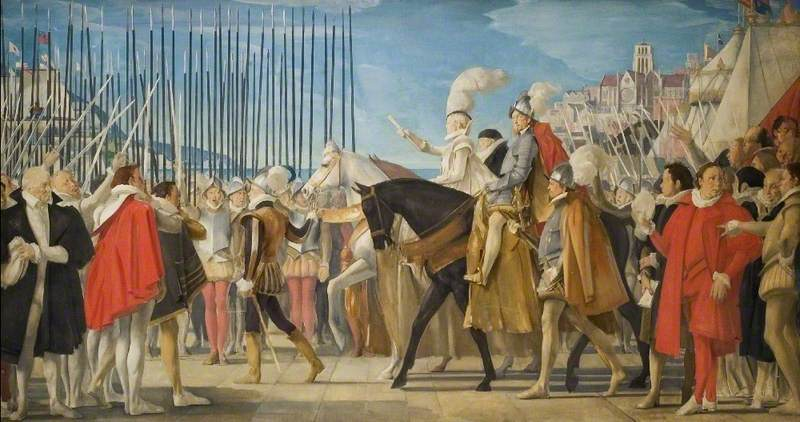
Despite the Scottish army outnumbering the English, it is thought that the outcome of the battle was due to the type of weapons used. At this time, the Scots favoured massed pike formations which worked well in battles of movement, but due to the slippery and uneven ground, the battle was not one of heavy advances and attacks. The English army mostly used a weapon called a bill, a long and hooked blade, which ended up working better in the battle as it cut through the Scottish lines. After this, ‘Flodden became known as the victory of bill over pike!’{2}
Sources:


Comments